
Patch placement on an Army uniform is set by regulation, and that's the one place where you don't get a vote. Plate carriers and tactical gear are different. There's no single chart, and the loop field on your gear decides what fits. Marines, Air Force and Navy follow their own regulations, so this guide covers Army OCP only. It also has Veterans Day in mind for anyone ordering reunion or memorial patches.
Where do patches go on an Army uniform and a plate carrier?
On an Army OCP coat, the U.S. flag goes on the right shoulder and the unit patch on the left sleeve. Name tape sits above the right chest pocket. On a plate carrier, there's no regulation chart. Use the front loop field for ID or morale patches, the shoulders for a flag, and the back panel for large ID.
Army OCP placement, patch by patch
For the Army Combat Uniform in the Operational Camouflage Pattern (OCP), placement follows AR 670-1 and DA Pam 670-1. Here's the short version, as the pamphlet lays it out:
- U.S. flag: right shoulder, with the star field facing forward.
- Unit patch (shoulder sleeve insignia): left sleeve, on the hook-and-loop field.
- Combat patch, if earned through wartime service: right sleeve, below the flag.
- Name tape: above the right chest pocket.
- U.S. ARMY tape: above the left chest pocket.
- Rank: centered on the chest.
Some guides online swap the name tape and the ARMY tape. The name tape is on the right.
This is a plain summary, not an official source. Regulations get updated, and your unit's leadership has the final say on what's worn and where. Check the current version on armypubs.army.mil before you buy anything for a uniform. TAP makes custom patches only. We don't make or sell official regulation insignia, and our patches aren't authorized for uniform wear.
Why does the flag look backwards on a military uniform?
It's not a mistake. The flag on the right shoulder is worn with the star field facing forward, so it looks like the flag is advancing as the soldier moves ahead. That's why it reads as reversed to most people. You'll hear it called the reverse-field flag.
If you're making a custom flag patch for a carrier, a range vest or a ball cap, you can use either orientation. For anything that's meant to match a uniform, follow the regulation and ask your unit.
Are morale patches allowed on a uniform?
It depends on the unit and the situation. Morale patches are informal patches with a unit joke, a motto or a design that's just fun. Whether they're allowed on a duty uniform is up to the commander and the current regulations. The answer is often no.
Where they're commonly welcome is on gear that isn't part of the regulated uniform: range bags, plate carriers worn off duty, airsoft kits, caps, jackets and backpacks. If you want a patch for a specific unit event, ask the people in charge first. We'd rather you check than guess.
How should you place patches on a plate carrier or tactical vest?
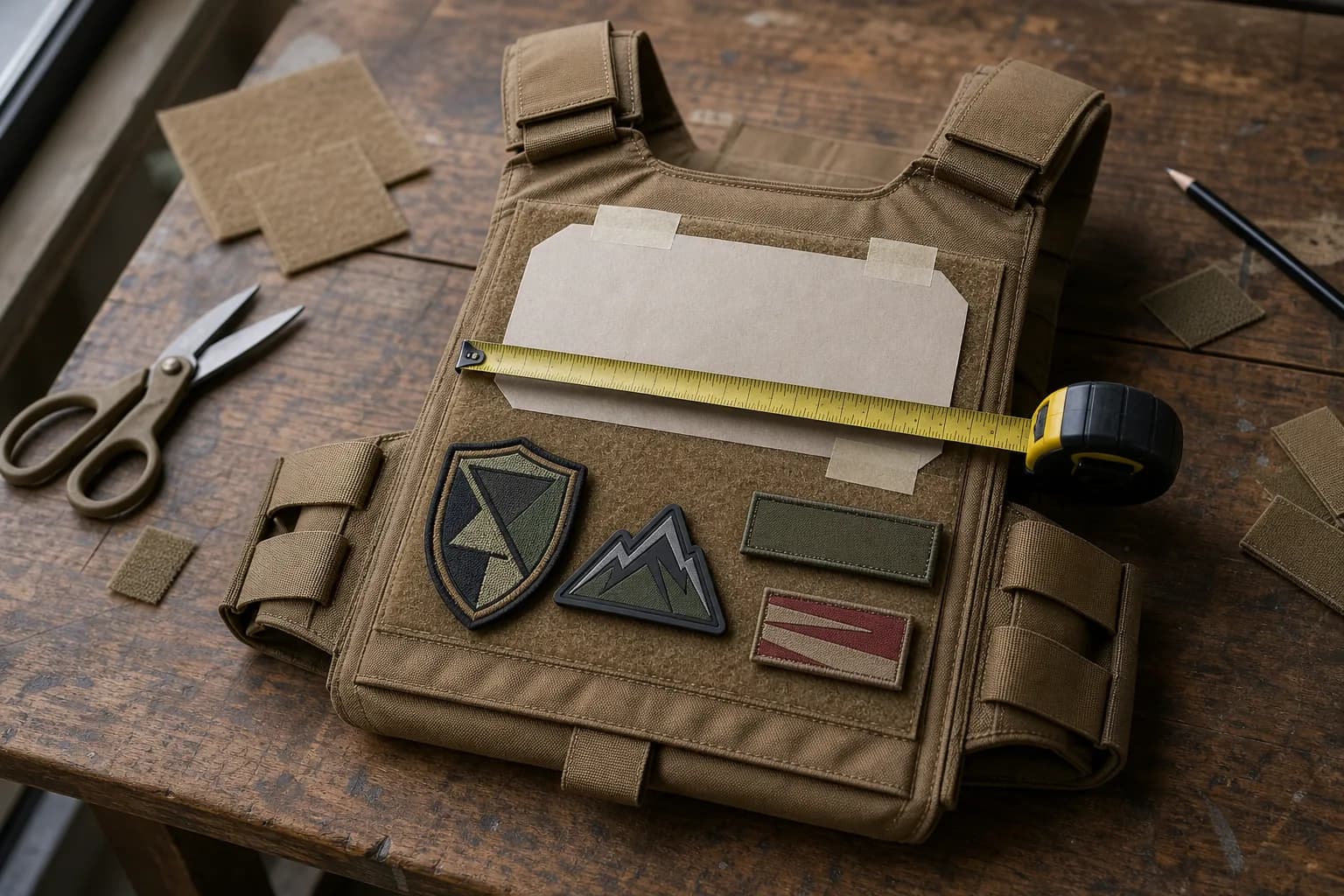
Plate carriers don't follow one standard. Most have a hook-and-loop (Velcro-style) panel on the front and back, plus smaller panels on the shoulders. The common layout looks like this:
- Front panel: ID or morale patches.
- Shoulders: a flag, an ID tag or an IR patch (infrared-reflective, visible with night vision).
- Back panel: a large ID patch such as POLICE or RESCUE.
- Chest or side spots: blood-type tabs and name tapes.
Sizes vary by carrier brand and model. Measure your loop field first, then order. A patch that hangs past the edge of the loop will peel at the corner. One that's too small looks lost.
What size patch fits which spot on gear?
Here are common starting points. They're typical numbers, not rules for every carrier.
| Spot | Typical patch size |
|---|---|
| Front panel (3 x 5 in field) | About 2.5 x 4.5 in |
| Front panel (4 x 6 in field) | About 3.5 x 5.5 in |
| Shoulder | 2 x 3 in or 3 x 3.5 in (measure) |
| Back panel | Large ID, measure the panel |
| Morale spot | 2 x 3 in or 3 x 3.5 in |
| Name tape | About 1 x 5 in (check yours) |
| Blood-type tab | About 1 x 3.5 in |
Sizes vary, so measure first. Leave a small margin around each patch so the hooks grip loop on all sides. Two patches that touch at their edges tend to lift each other.
How many patches should you put on one piece of gear?
Three to five is a good range for most carriers. More than that and the layout gets crowded. The patches fight each other for loop space, and nothing reads clearly.
A few placement habits help. Don't cover zippers or straps, because patches can jam the closure or rub through. Keep the medical pouch clear so anyone can get to it fast. Put the patch you most want seen at chest height on the front. Then lay everything out before you commit. Cut paper shapes at real size, tape them to the loop panel, and look at the whole layout from a few feet away.
What backing do patches need for hook-and-loop gear?
Anything going on a loop panel needs a hook backing, which most people call Velcro. The patch's back has a hook layer, and the gear has the loop layer. That's what lets you swap patches in and out in seconds.
At TAP, every patch can be ordered with any backing: sew-on, iron-on, Velcro or peel-and-stick. The Velcro backing doesn't change the price. If you're ordering for a team, see our custom Velcro patches page.
Skip iron-on for nylon or coated tactical gear. Heat can melt the fabric, and waterproof coatings stop the glue from bonding.
Which patch type is best for tactical gear?
It depends on the look and the weather.
PVC patches are molded from soft PVC, a rubbery plastic. They hold up well in rain and mud, which is why they're common on tactical gear. They suit bold, simple designs. The tradeoff is weight. PVC is heavier and stiffer than embroidery, so a big one can sit proud on a curved shoulder panel.
Embroidered patches give you the classic stitched look and a softer feel. They're a good fit for unit patches and reunion patches. Very fine lines can fill in with thread, so keep small text readable.
For small text and name tapes, look at woven patches. Woven thread is finer, so tiny letters stay sharp.
If you're not sure, browse the custom tactical patches page and compare. For something fun and informal for a team or a range group, start with our custom morale patches page.
Should you pick subdued or full-color patches?
Pick based on how the gear is used. Subdued patches use muted tones, such as tan, olive and gray, so they blend with camouflage and don't draw attention. Full-color patches stand out. That's the point on caps, jackets, a range vest or a reunion keepsake.
Airsoft players and range shooters often keep ID patches subdued and add one full-color morale patch for personality. Families making memorial patches usually go full color so the details read clearly. When you send us your artwork, tell us which look you want. The free digital proof will show you the colors before anything is made.
What can you make for Veterans Day, a reunion or a memorial?
Veterans Day is when many people start asking about keepsakes. A patch works well for that, because it's small, it lasts, and it can go on a jacket, a cap or a bag.
Say a platoon is planning a 40th reunion. One patch could carry the unit crest and the years served. You'd order a small run, just enough for the members who are coming. A memorial patch for a family can follow the same idea, with a name, a unit mark and a date.
These are keepsakes, not official insignia. They're meant for jackets, caps and display, not for wear on a duty uniform.
How do you order custom patches for a unit, reunion or team?
The steps are short:
- Measure your loop field, or decide the size you want for a jacket or cap.
- Send your artwork. A rough sketch or photo works too, and we'll redraw it for free.
- Check the free digital proof on your phone at actual size.
- Approve it, or ask for changes, before production starts.
Price comes down to size, number of colors and patch type. A bigger patch with more colors costs more than a small, simple one.
There's no minimum order, so a six-person team or one single morale patch is fine. Shipping is free worldwide, and production is overseas. Every order has a 14-day guarantee. Jerry William, the owner, has 15+ years in the patch industry.
Ready to start? Send your artwork for a free proof.