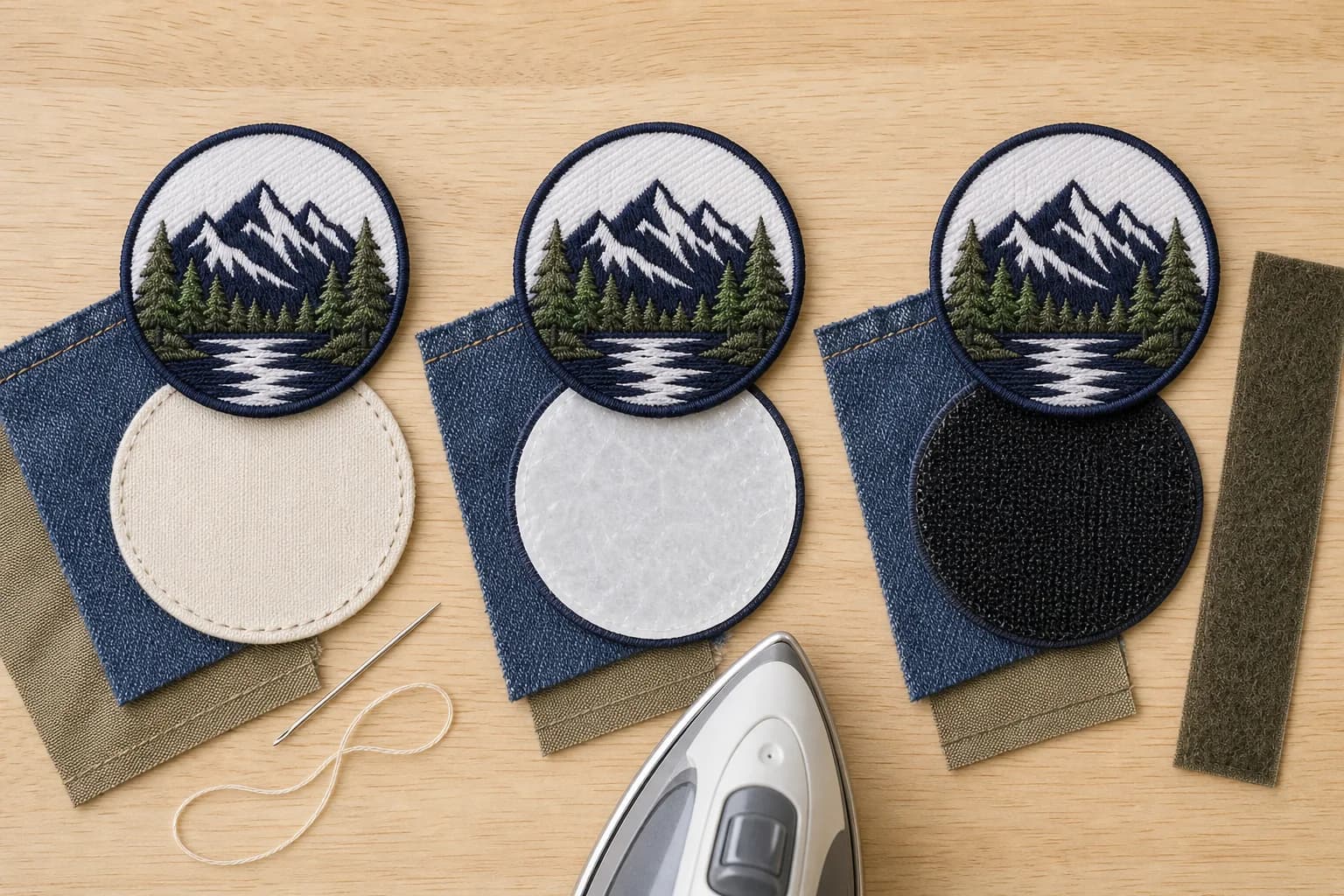
Sew-on is the strongest backing, iron-on is the easiest, and Velcro is the one you can swap out. Which one is right comes down to your fabric, how long the patch needs to last, and whether you'll ever want to move it.
Pick sew-on if the patch needs to last for years on a jacket, bag or uniform. Pick iron-on for quick, light-duty jobs on cotton, denim or canvas. Pick Velcro if you swap patches often, like on tactical gear or name tapes. If you're unsure and the fabric is cotton, denim or canvas, iron-on plus a few stitches around the edge covers most everyday cases.
| Backing | Best on | Avoid on |
|---|---|---|
| Sew-on | Most fabrics | Finished leather, taped seams |
| Iron-on | Cotton, denim, canvas | Nylon, polyester, leather, knits |
| Velcro | Gear with a loop panel | Soft knits |
| Peel-and-stick | One-day events | Anything washed |
How does each backing work, and where does it fall short?
Every backing has a real weakness. Knowing it up front saves you from a patch that peels at the corners or can't come off.
- Iron-on: A layer of heat-activated glue on the back melts into the fabric and bonds as it cools. Where it fails: the edges lift first, especially after repeated washing.
- Sew-on: A plain fabric back that you stitch down by hand or machine. It's the most durable and works on nearly any fabric that takes a needle. The catch: crooked stitching shows, and it's the hardest to undo cleanly.
- Velcro (hook and loop): The hook side goes on the patch, and the loop side usually gets sewn onto your garment or bag. Stick-on loop panels exist, but they don't hold as well. You can swap patches in seconds. Weak spot: the hooks can snag soft knits.
- Peel-and-stick: Quickest of all, but only for flat, temporary use, so treat it as a stopgap rather than a real backing. Weak spot: it won't last through the wash.
Our iron-on patch guide covers heat and timing, so we won't repeat those details here.
Which backing works on which fabric?
Fabric is the biggest factor, and it rules out options faster than preference does.
- Cotton, denim and canvas: These handle heat well, so iron-on works nicely. Sew-on is still stronger if the item gets heavy use.
- Nylon and polyester: Be careful. Heat can scorch, shine or even melt these fabrics, and a melted spot can't be repaired. Slick coatings also keep the glue from gripping. Sew-on or Velcro is the safer call.
- Leather: Heat can mark the surface, and the glue doesn't hold well on finished leather. Sewing works, but needle holes are permanent, so place the patch carefully.
- Knit and stretchy fabric: The fabric stretches and the glue doesn't, so iron-on tends to crack or peel. Use sew-on with relaxed stitches.
- Velvet and satin: Velvet's raised, fuzzy surface (the pile) crushes under an iron, and the glue only sits on top of the fibers. Satin can show heat marks. Sew-on is the better choice for both.
- Hats: Curved, stiff crowns are hard to press flat. Iron-on can work on a soft cotton cap, but stitching holds better. See our custom hat patches.
- Waterproof gear: Coated fabric won't take iron-on glue. Sewing puts small holes in the coating, so keep patches off the taped seams and dab seam sealer over the stitches.
What about a nylon rain jacket?
This one trips people up. The shell is slick, coated and heat-sensitive, so iron-on fails twice over: the glue can't penetrate the coating, and the iron can melt the nylon. A patch that looks fine on day one tends to lift at the corners after washing.
Go sew-on. If you want to swap patches, sew a loop panel on first and use a Velcro patch. Either way, place the patch away from seams so you don't open a path for water.
Common backing mistakes
Too little heat or pressure is the quiet one. The patch looks stuck but lifts at the edges: if you can get a fingernail under an edge once it's cool, the bond is bad. The other is skipping edge stitches on anything you'll wash often.
Velcro has its own trap. Skip it if the garment has no loop panel and you don't want to sew one on, since the patch has nothing to grab. And if the patch will never move, plain sew-on is simpler and sits flatter.
Which backing fits your use case?
Match the backing to how the patch will be used.
- Jackets and vests: Sew-on is the standard, since these get worn and washed for years. Iron-on plus stitching works too. Browse custom jacket patches for ideas.
- Uniforms and tactical gear: When names, ranks or unit patches change, hook-and-loop is the usual pick (see Velcro patches). You swap the patch, and the garment stays untouched.
- Hats: Sew-on is the most reliable. Velcro suits caps with a loop panel on the front.
- Kids' clothes: Iron-on is convenient on cotton, and kids are rough on clothes, so expect to re-stick it now and then.
- Bags and backpacks: Sew-on is best for canvas and nylon. Velcro works if you like changing the look.
- One-time costume: Iron-on or peel-and-stick is plenty for something you'll wear once or twice.
Can you use two backings on one patch?
Yes, and plenty of people do. Iron-on glue holds the patch flat so it doesn't slide while you sew. Then stitches around the border, spaced about an eighth to a quarter inch apart and sewn just inside the edge, lock it in. You get iron-on speed with sew-on strength.
It also works the other way. You can sew an iron-on patch straight onto nylon without ever heating it. The glue can gum up the needle, so use a slightly heavier needle and wipe it clean now and then.
Size matters too. A back patch wider than about 4 inches carries real weight and flexes with every move. Stitch it even if you iron it first.
Which backings can you order from us?
Any of them, on any patch. Sew-on, iron-on, Velcro and peel-and-stick are all available on every patch we make, and choosing Velcro doesn't change the price. So you can pick the backing that suits your fabric without trading off the patch type or the budget.
Ready to test one?
Check the backing against your fabric before you commit. Every order starts with a free digital proof before production, so look at it on your phone at actual size. There's no minimum order, so you can order as few as 1 piece and test a backing on your own fabric first.
Pick your patch type, then choose the backing when you order. Want the iron-on kind? See custom iron-on patches.